Rounded shoulders are one of the most common posture patterns seen in people who spend hours at a desk or on a phone. In the clinical literature, this pattern — often combined with forward head posture — is known as upper crossed syndrome (UCS). Here is what the research says about why it happens and how to address it.
What is upper crossed syndrome?
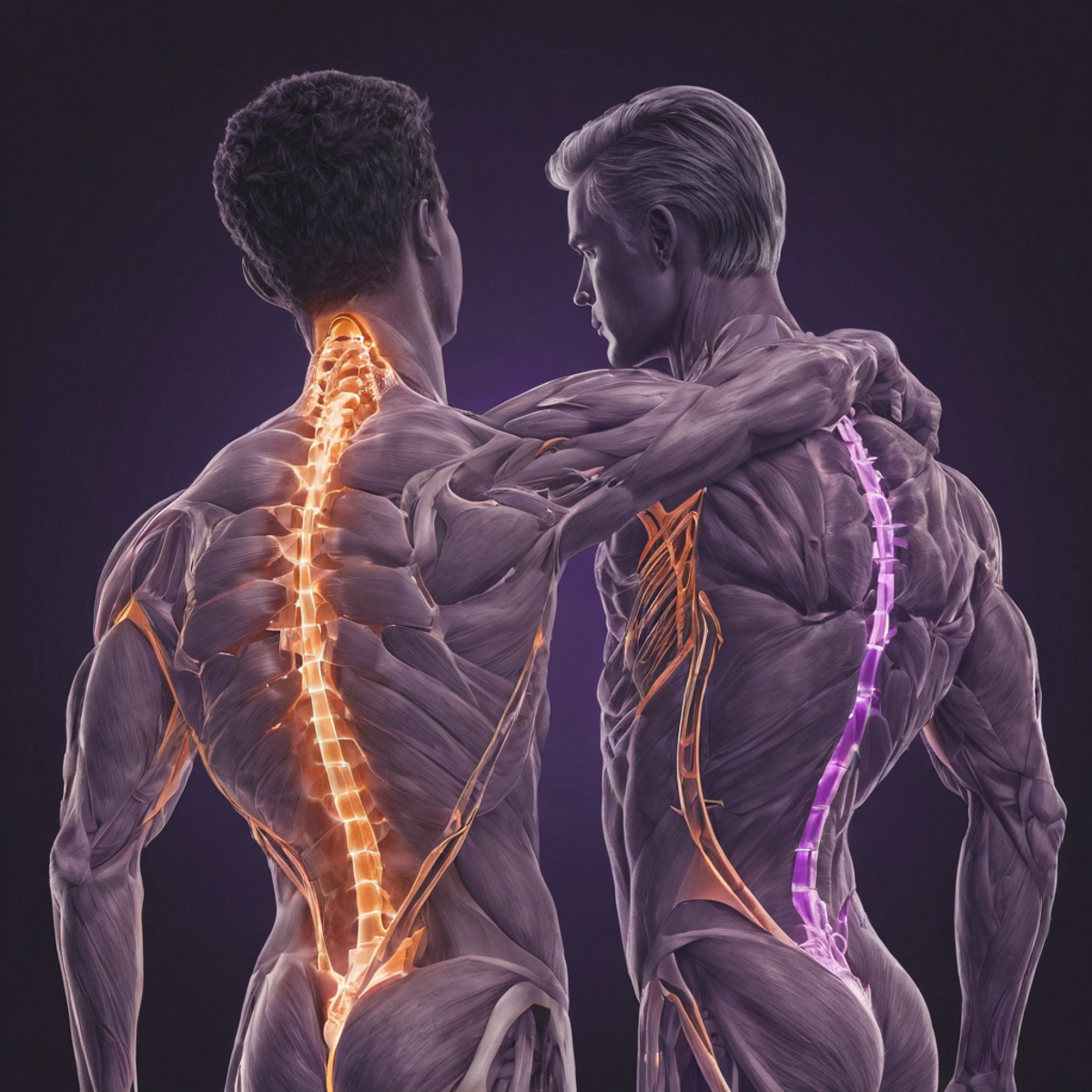
Upper crossed syndrome describes a posture pattern characterized by tightness in some muscle groups and weakness in their opposites, in a "crossed" arrangement across the upper body. Specifically:
- Tight: the upper trapezius, levator scapulae, and pectoral (chest) muscles
- Weak: the deep neck flexors, lower trapezius, rhomboids, and serratus anterior
This is why people with rounded shoulders often have a forward head and a hunched upper back — the muscles that should hold the shoulders back and the head up are underactive, while the muscles pulling the shoulders forward are overactive and tight.
Why it happens
The pattern is classically associated with prolonged postures — desk work, driving, and heavy phone use — where the arms and head are held forward for long periods. Over time, the body adapts to these positions: the front muscles shorten and tighten, and the back muscles lengthen and weaken.
This muscular imbalance can have consequences beyond looks. Forward shoulder posture is associated with reduced shoulder range of motion, altered muscle activation, and in some cases, discomfort or impingement-like symptoms in the shoulder and upper back.
What the evidence supports
The research on postural exercises consistently points to two complementary strategies:
1. Strengthen the weakened muscles
Exercises that target the mid-back and shoulder retractors — rows, scapular squeezes, and lower trapezius work — help train the muscles that hold the shoulders in a neutral position. Over time, this improves posture and supports better shoulder mechanics.
2. Stretch and release the tight muscles
Gentle stretching of the chest (pectoral muscles) and upper traps, combined with awareness of position, helps reduce the pull that draws the shoulders forward.
As with forward head posture, randomized trials on postural exercise generally find that consistent, structured programs — combining strengthening and stretching — produce meaningful improvements. The specific exercise selection matters less than regularity and correct execution.
A practical warning: exercise alone isn't enough
No amount of exercise fully overrides hours of poor daily posture. The most effective approach combines short strength and mobility sessions with ongoing awareness and regular position changes throughout the day. An app that prompts you to do a short guided session daily — while reminding you to reset your posture during the day — is well aligned with this evidence.
How Posturist helps
Posturist's guided program includes the upper back strengthening and chest-mobility work that supports better shoulder posture — structured into short daily sessions with clear instructions and progress tracking.
Start your posture program
Guided daily workouts for better shoulder and spine alignment.
References
- Mahmoud NF, et al. The Relationship Between Forward Head Posture and Neck Pain: a Systematic Review and Meta-Analysis. Current Reviews in Musculoskeletal Medicine. 2019. PMC6942109
- Randomized clinical trial comparing neck stabilization versus dynamic exercises for nonspecific neck pain with forward head posture. BMC Musculoskeletal Disorders. 2024. PMC11373259
This article is for educational purposes and is not a substitute for professional medical advice.